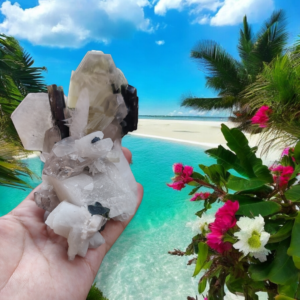
A major group of minerals is known as tourmaline; the silicate minerals containing boron. These minerals are related in terms of crystal structure and overall physical characteristics – yet differ mind-blowingly in the chemical makeup. Due to this great variety of compositions, and color zoning in crystals, tourmaline comes in more colors and color combinations than any other mineral group.
Tourmaline is among the most common and some of the in-demand gemstones in the world and it is also a birthstone in October. Due to its popularity tourmaline can be found readily in jewelry stores. Mineral specimen collectors also collect well-formed tourmaline crystals. That specimen may be attractive in color and crystal shape can sell into thousands of dollars.
 Geologic occurrence of tourmaline
The most common form of tourmaline is the accessory mineral rock that is found on igneous and metamorphic rocks. Well-formed crystals of tourmaline up to large dimensions may be grown in fissures and cavities during hydrothermal actions. Tourmaline is tenacious and hard rock. That allows it to survive the processes of stream and beach transportation as well as resistant grains in the sediments and sedimentary rocks.
Hydrothermal activity occurs and results in the formation of the most spectacular tourmaline crystals. These crystals are produced when hot waters and vapors transport the elements that are required to transform tourmaline into pockets, holes, and cracks which give an open surface on which the crystal can grow. Crystals of tourmaline grew in these cavities, some of these crystals are millimeter-sized; they are large prismatic crystals weighing more than 100 kilograms.
Alluvial Tourmaline
Mohs hardness of tourmaline was 7 to 7 1 / 2 and this aspect of hardness makes it a hard sediment granule. Tourmaline is somewhat chemically weather resistant as well. Thus, i.e. tourmaline particles eroded by weathering of igneous or metamorphic rocks are able to remain in a stream where it can reach far distances out of their source area.
In most regions of the globe Stream sediments are mined and the tourmaline gem rough is typically found by artisanal miners. It mostly takes the form of small granules and pebbles which have been rounded due to abrasion offered by the streams during transportation. Tourmaline in many cases is just part of a variety of other minerals mined in just one site.
As ourmaline Accessory Mineral
Tourmaline is mostly found as accessory mineral in igneous and metamorphic rocks. It is commonly found in the form of millimetre-sized crystals distributed within granite, pegmatite or gneiss. In this form of occurrence tourmaline is all too seldom in an abundance greater than in a few per cent. of the volume of rock. Black schorl is the accessory tourmaline that is found most frequently.
Tourmaline Sources
Brazil is the largest producer of tourmaline ever in the world and the production has been going on now over 500 years. During the 1500s the Portuguese discovered tourmaline in green and blue when made available to them by natives and when panning river-beds in pursuit of gold. They believed these coloured rocks were emeralds and sapphires and shipped them back to Portugal where they were cut into jewels and turned into ornaments worn by royalty and rich people of the country. Tourmaline did not exist as an independent mineral until 1793.
Starting with discoveries in the later eighteenth century, the continuous flow of tourmaline discoveries in the pegmatite of Minas Gerais, Brazil, has been gained since the late nineteenth century. Since that time there has been a production of millions of carats of tourmaline in the large variety of colors and much bicolor product also. This various flow of tourmaline in Brazil has been the most vital resource of the global gem and jewelry industry.
In 1821 a tourmaline discovery near the town of Paris, Maine led to the first commercial gemstone mine in the United States. In the last 2 centuries large quantities of pink and green tourmaline have been mined in Maine at scores of localities.
The tourmaline mines of southern California have been the richest source of tourmaline of the United States. The mining of tourmaline dates back into the late 19th century. A cumulative dollar value approach shows that tourmaline has been the most valuable gem material that has been found in California. Majority of this production was done more than 100 years ago in both Riverside and San Diego Counties. It contained tons of red tourmaline, which were sent to China to make snuff bottles, carvings, jewelry among many other objects. Small-scale mining is in place today generating a small amount of tourmaline. To-day the miners dispose of a lot of the finest of their output as mineral specimens.
The tourmaline of different types is found today in Afghanistan, Mozambique, Namibia, Nigeria, Pakistan, Tanzania, in the United States, and some others. These supply the market with ever-changing supply of gem tourmaline and mineral specimens.
 Tourmaline Physical Properties
Tourmaline possesses some qualities that can be useful in identifying this mineral. Identification of a tourmaline crystal can be simple in case of possession.
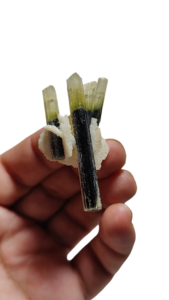
Tourmaline has prisms crystal habit and also with evident striations facing the long axis of a crystal.
Tourmaline auxiliary crystals are usually found in the form of triangular or tri-lateral cross-section with rounded edges.
The tourmaline is commonly color zoned across their cross-sections and down their length.
Tourmaline may also be pleochroic darker color along C-axis and brighter color along the C- axis.
Even when your suspected tourmaline is an accessory mineral in an igneous or metamorphic rock do not despair. In these rocks it frequently appears in the form of very small prismatic crystals. Take a hand lens and examine striations and cross-sections which are rounded.
Tourmaline cleaves indistinctly, and therefore any specimen which exhibits distinct cleavage is not likely to be tourmaline. This may not be beneficial to color. Black is the most typical color in tourmaline although the mineral was found to exist in all the colors in the spectrum.
Paraiba – The Most Valuable
When people like tourmaline, then they perk up after hearing the name Paraiba. In 1989 and 1990 some spectacular bright blue to bright green elbaite tourmaline, colored by traces of copper, was discovered in pegmatite pockets at mines in the states of Paraiba and Rio Grande do Norte, Brazil.
In a later issue specimens of violet were discovered with traces of both copper and manganese. These gems were wonderful in color. The saturation of the colors and how vivid and bright they were has led to many describing them as being electric and neon as far as the adjectives to describe them went.
Informally the material became known as “Paraiba” after the locality. The beautiful gems started fetching more than $2000 per carat soon and this news rocked gemstone markets across the world.
People were fond of those gems, of the color of them, of the exotic name. High quality material in the largest faceted gems was driven up to over 10,000 dollars (per carat). The Paraiba was the most popular and precious tourmaline that was very fast.
There was the first excited outcry about these jewels, which was over their very nature of their colour. In a short time anyone who needed to get quick money was calling all tourmalines found in the state of Paraiba “Paraibas” in the hope that it would increase the value of their sale.
Other nuggets of the same kind were discovered in Nigeria in 2001, some instantaneously referring to them as gems- again with the hope that it will hike their price. Further ones were 2005 in Mozambique. Individuals with blue or green tourmaline in numerous regions of the globe wanted to sell their stuff at a “Paraiba price” – but are these stones really any such thing as Paraiba?.
The name Paraiba was in use on grounds of locality, colour and on grounds of the metal that causes the colour. The brand-name Paraiba was already misused in too many ways – and marketplace confusion was already seething.
An article in Gems & Gemology (August 2006) stated that the saturated blue-to-green colored Nigerian and Mozambique tourmaline is not differentiated by normal gem testing methods relative to the Brazilian material, but that trace elements could be employed to differentiate the Brazilian, Nigerian and Mozambique tourmalines.
Such is the point, then, what is the true Paraiba? A decent response would be like this, What is a true Burmese ruby? It is a jewel of supreme beauty of a certain place (Burma, nowadays called Myanmar) and some are even ready to spend a lot more on it. This is why rubies in Madagascar which look very similar do not move at a Burmese price.
That a name, a locality, a color, should at once create value in a gem, is not to be presumed.
Remember that when a seller sells you “Paraiba tourmaline”.
First of all, when you own or are thinking about acquiring a “Paraiba tourmaline”, it is essential to keep in mind that phenomenal color is what burgeoned the madness over these rocks. Just be sure that you are purchasing great color. Then there are a lot of buyers who will pay premium price of gemstones that have originated in the original Paraiba localities in Brazil and there are also people who would want to purchase only gems with natural and untreated color. Most gemologists are not qualified to determine this information nor is the equipment readily available.
The Gemological Institute of America (GIA) laboratory is one of the fine establishments to do it at. Under fingerprinting, they provide Colored Stone Identification and Origin Report on specific Paraiba tourmalines. By submitting your gem to GIA one of these reports they will give you their view as to geographical source of the gem, and tell you of any treatments they have seen. To learn more about the process read GIA article on the geographic source of paraiba tourmaline.
African tourmalines of the fantastic neon and electric colors are all right. Based on the color they can fetch a high price. But those disagree that these gems should be called Paraiba. They are of the view that marketing a gem using geographic place name whereby a gem does not originate in that place may be confusing, or which is worse, misleading.