


Rhodochrosite is a bright to light red colour Carbonate mineral of manganese. It can be traced in a few places globally where other manganese minerals tend to be in existence.
Rhodochrosite is occasionally employed as a manganese ore, and is occasionally found in economic concentrations. The highly desirable gemstones are made using the specimens that have a wonderful pink color. Rapid crystals can become quite precious as mineral specimen since rhodochrosite are very rarely found in crystallinic form.
Physical and Chemical Properties
Rhodochrosite is variable in its chemical composition. It is a carbonate of manganese, although iron, magnesium and /or calcium often substitute manganese in this formula: (Mn,Fe,Mg,Ca)CO3.
These replacements of other substances to manganese alter the composition and also the specific gravity, the hardness and the color of the mineral. In reaction to this chemical variation, the bright pink colour may be changed to grayish or yellowish or brownish. There exists complete solid solution sequence between siderite (FeCO3) and rhodochrosite.
Rhodochrosite is not so difficult to identify, and is not frequently mistaken with other ones. The pink color, its cleavage in three directions perfection, low hardness and the easy effervescence with cold dilute hydrochloric acid, are not often met with in other minerals.
The greatest distraction lies in the names of these two minerals; rhodochrosite and rhodonite, both are pink and manganese-bearing minerals and people cannot spell them easily because they almost sound alike.
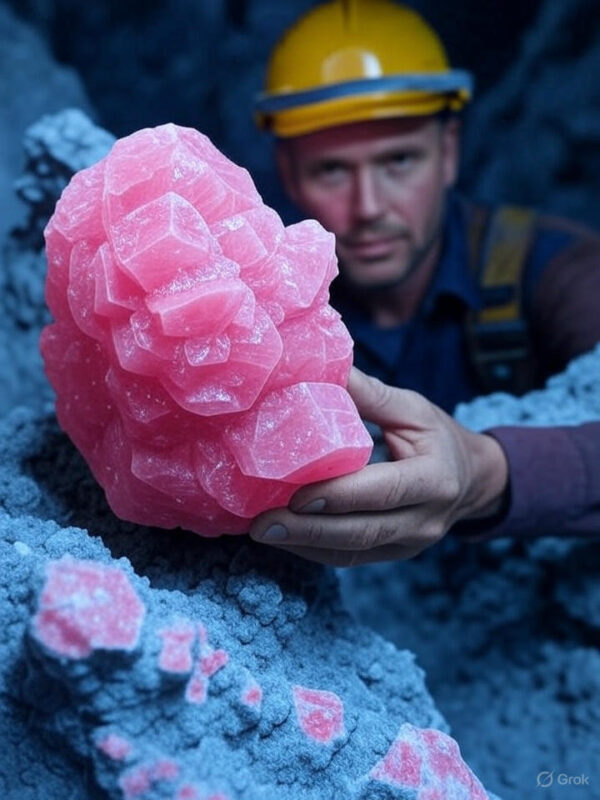 Geologic Occurrence
Rhodochrosite is generally formed within metamorphic and sedimentary rocks fractures and cavity. It is also largely connected with silver ores and several silver mines yield rhodochrosite as a byproduct
Rhodochrosite occurs as a vein and fracture fill in metamorphic rocks in which it grows as the result of uprising hot water. The repeated period of crystallization permits it to accumulate in layers on the walls of the crack. Each layer is able to be a unique precipitation event and create material with slightly different pink color. This characterizes the material into lapidary use.
An excavator generally extracts the rhodochrosite out of the wall rock of these veins and cuts them into thin slabs using a diamond saw. The slabs can be made into cabochons, small boxes, other lapidary work etc.
Rhodochrosites are sometimes precipitated in pore spaces of sedimentary and metamorphic rocks as they receive an influx of dissolved material as subsiding solutions pour into pore spaces. The rhodochrosite collects in layers on the sides of the cavity in these deposits and may form stalactites and stalagmites in the roof and floor of the cavity – as do speleothems in a cavern.
These are frequently quarried out and slabbed up producing material of concentric pink banding. Some of the most excellent specimen of this kind of rhodochrosite are those occurring at the Capillitas station in Argentina, and the Catamarca.
Rhodochrosite is particularly rare in form of well-formed crystals. The Sweet Home Mine, at Alma, Colorado, is one of the very few places in the world where they occur. Firstly, opened as a silver mine in 1873, the rhodochrosite was neglected at that point. When the activity of mineral collectors grew, then, the nice crystals of the Sweet Home Mine began to be prices far more often than the lapidary rock. Superlative, miniature, hand-size specimens are now commanding five-figures. Faceting rough in some cases includes broken or damaged crystals.
Lapidary and mineral specimen richester are only deposited in constrained places in the world. Such countries are Argentina, South Africa, Peru, Montana, Colorado Russia, Romania, Spain, China, Gabon, Mexico and Japan.
Rhodochrosite Gemstone
Rhodochrosite is a gem of most people. It is usually slabbed in order to flaunt its banded or concentric designs. A majority of the slabs will be cut into cabochons.
Rhodochrosite is hard to cut as the material possesses perfect cleavage, it is also so soft to the extent that it may be challenging to polish. Small boxes and other ornaments Sometimes small boxes and other ornaments are made of nice, stable, slabbed material. The translucent which may not be used as a mineral specimen is occasionally faceted into pretty pink and red gems. The resulting beautiful stones are primarily destined into the hands of the collector as faceted rhodochrosite is way too fragile to be utilized as jewelry by practically any system.
Rhodochrosite is so soft to touch a rating of 3.5 to 4 and is perfectly cleaved along three directions. This rules it out as a possible excellent selection as a stone in a ring or bracelet where abrasion or stress may occur. It is more applicable in earring, pin and pendants which are less prone to abuse compared to the ring.
Imitation Rhodochrosite
The gem and jewelry market has beads and cabochons of imitation rhodochrosite. These consist of powdered mineral substance, in pink and white, and held in a resiny mass. Its powders are swirled and layered to form banded effect as in most natural rhodochrosite.
The material resembles the rhodochrosite to the naked eye. But suppose you have seen a lot of it, you will guess it is an imitation, but any one who has not seen very much of it will think it is natural rhodochrosite.
Microscopically the pink substance is translucent, having sugary reflection of the middle visible through the polished surfaces. The bubbles seem to be in the form of round depressions on the polished surface. Surfaces that are broken possess granular-sugary appearance.
Physical Properties of Rhodochrosite
| Property | Description |
|---|---|
| Chemical Formula | MnCO₃ (Manganese Carbonate) |
| Color | Pink, rose-red, red, brown, gray; sometimes banded or multicolored |
| Crystal System | Trigonal |
| Crystal Habit | Tabular, rhombohedral, massive, stalactitic, or botryoidal |
| Luster | Vitreous to pearly |
| Transparency | Transparent to translucent |
| Hardness (Mohs) | 3.5 – 4 (relatively soft, prone to scratching) |
| Specific Gravity | 3.5 – 3.7 (varies with manganese content) |
| Cleavage | Perfect in three directions (rhombohedral cleavage) |
| Fracture | Uneven to conchoidal |
| Streak | White |
| Refractive Index | 1.597 – 1.817 (birefringent) |
| Pleochroism | Weak to distinct (pink to colorless) |
| Luminescence | May fluoresce pink or red under UV light |
| Solubility | Soluble in dilute hydrochloric acid with effervescence (releases CO₂) |
| Occurrence | Found in hydrothermal veins, metamorphic rocks, and as a secondary mineral |