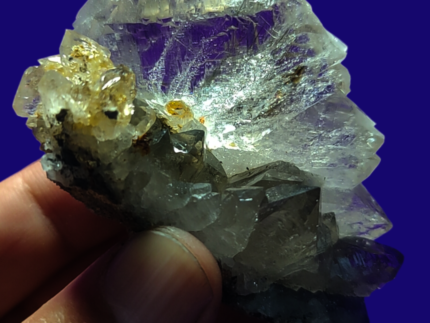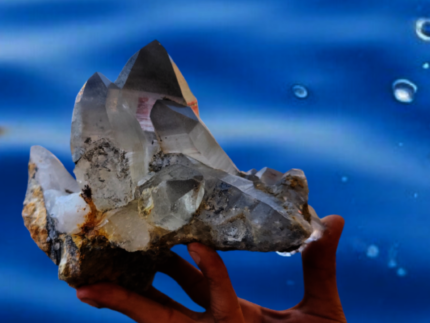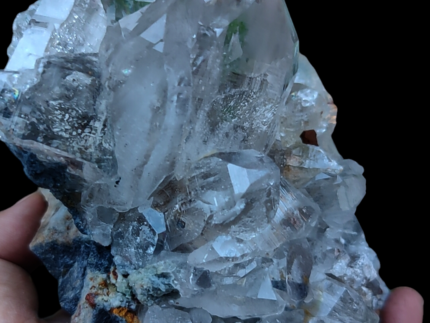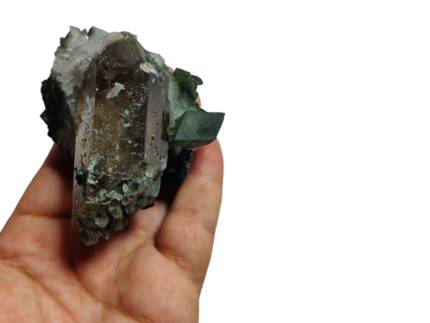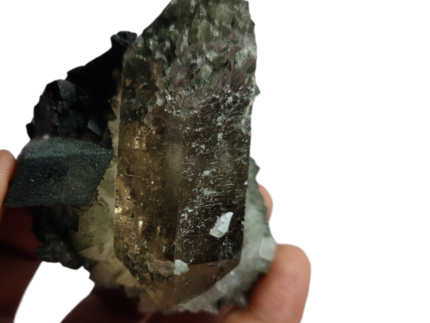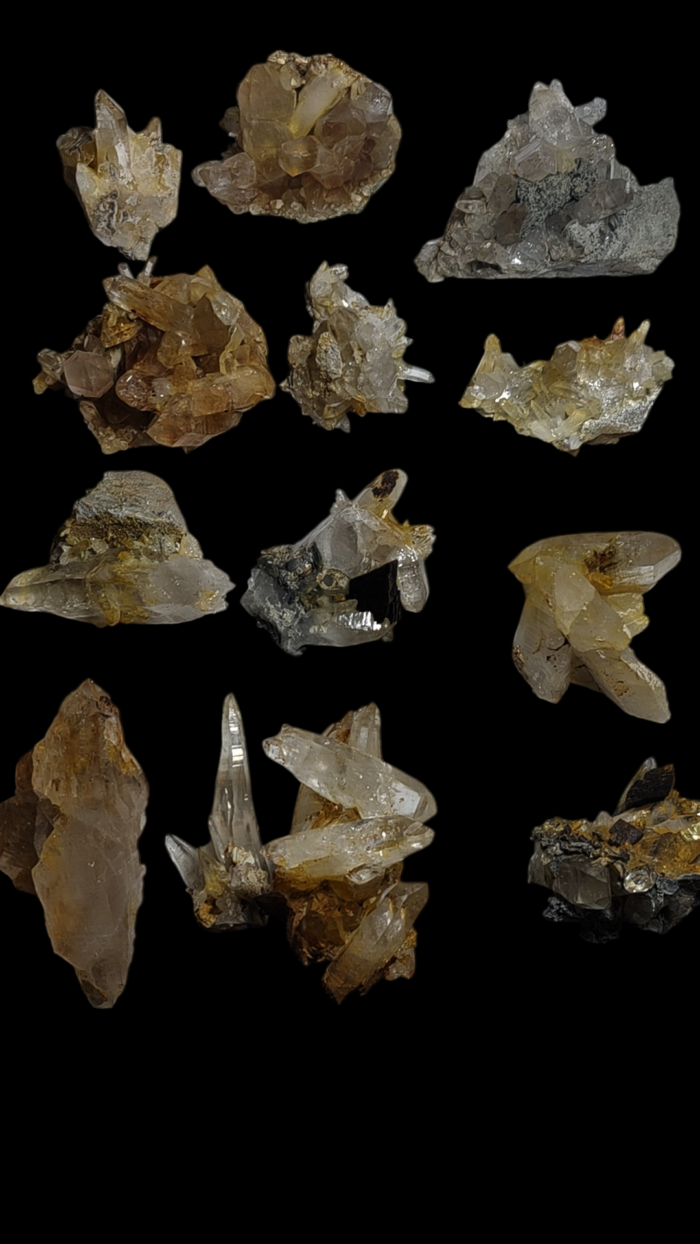
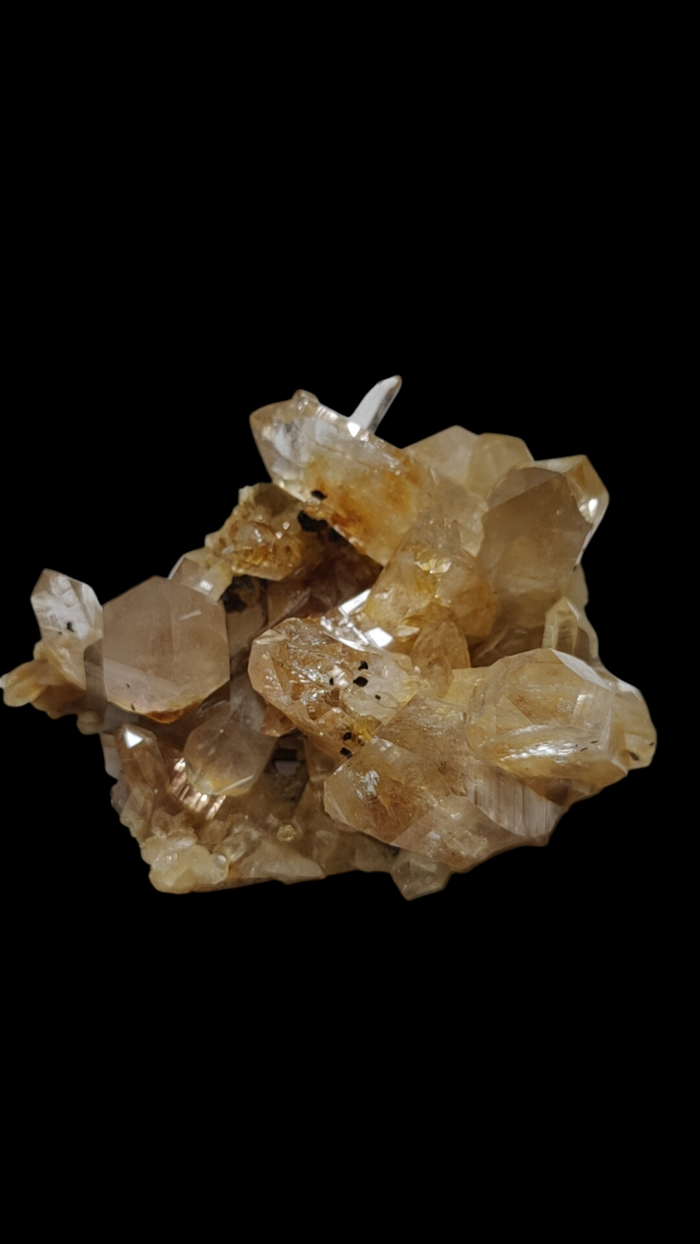

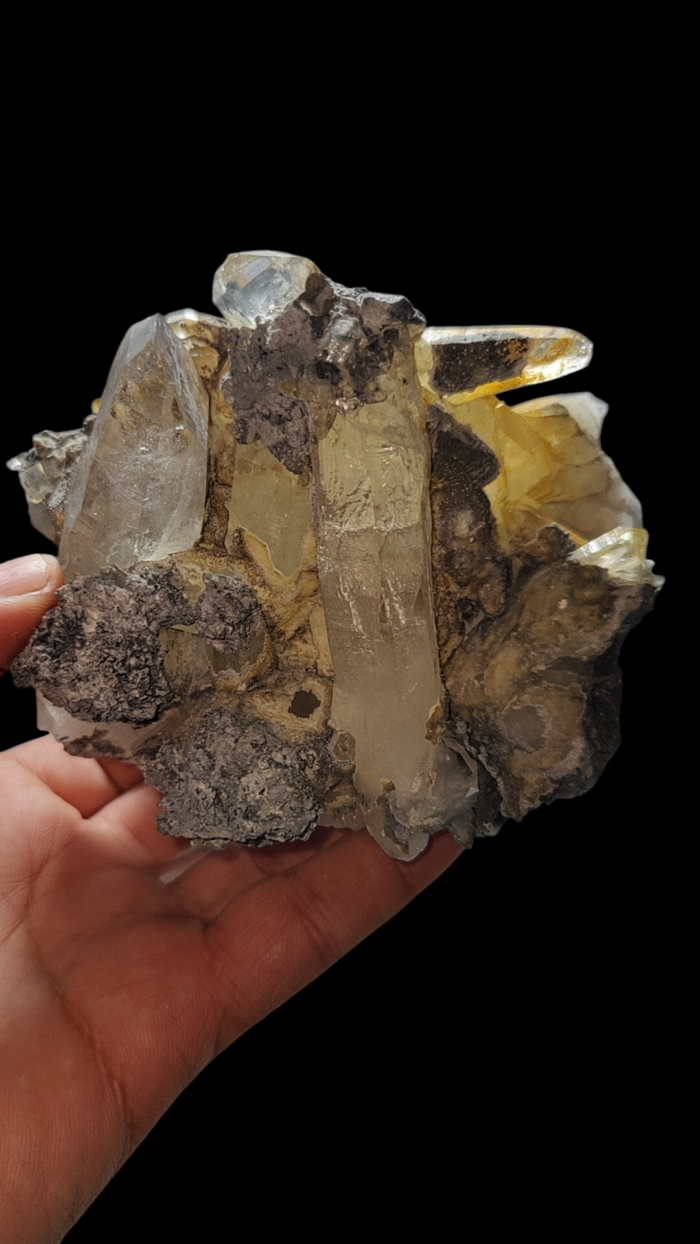

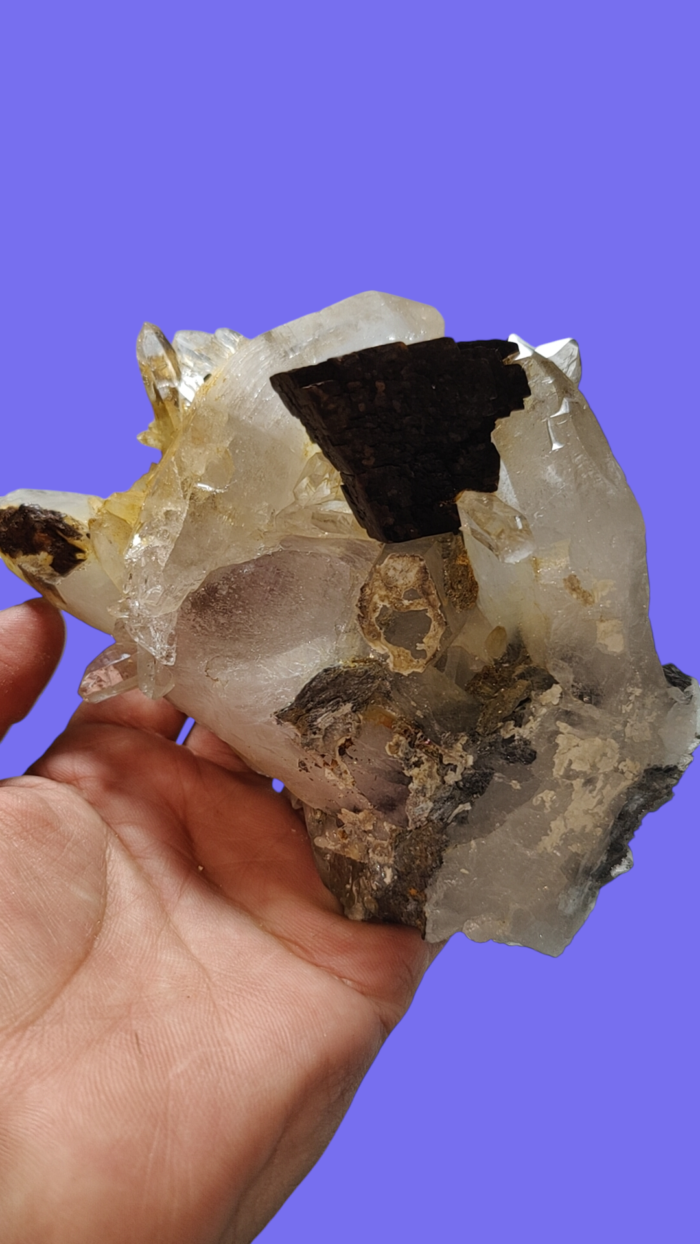
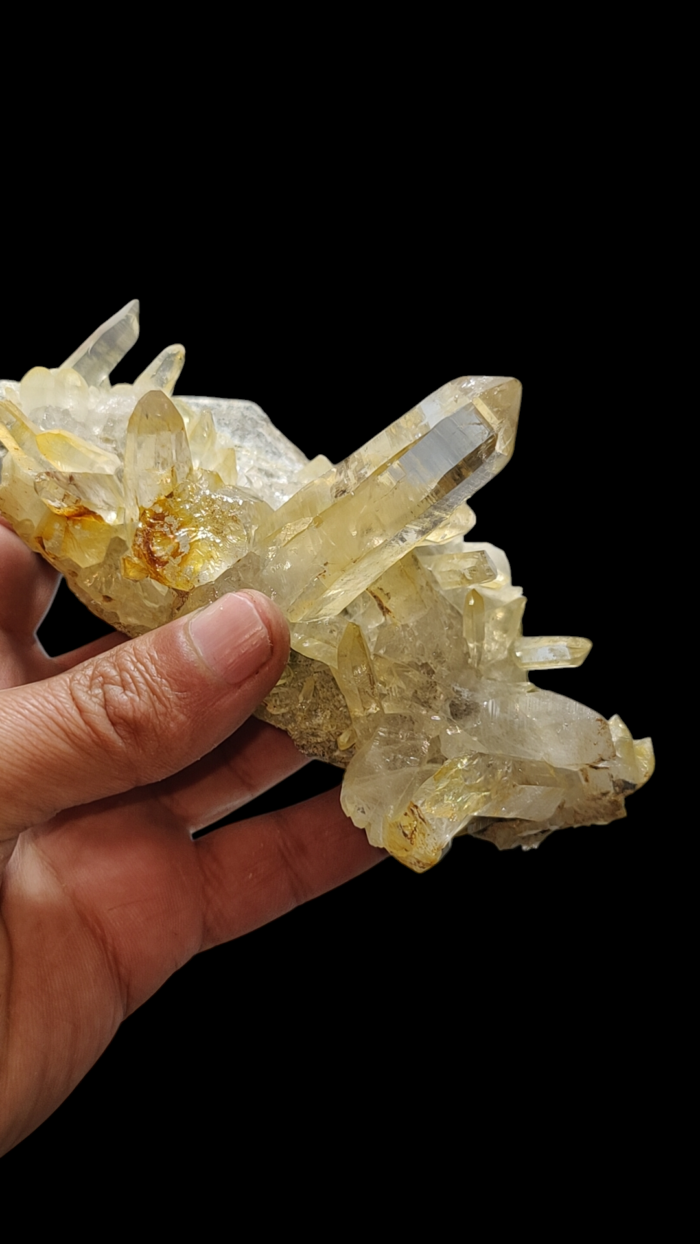
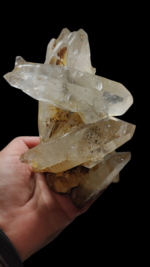
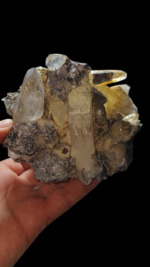
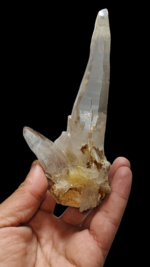
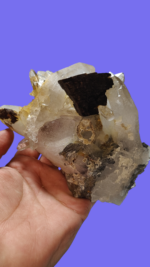
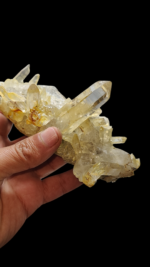


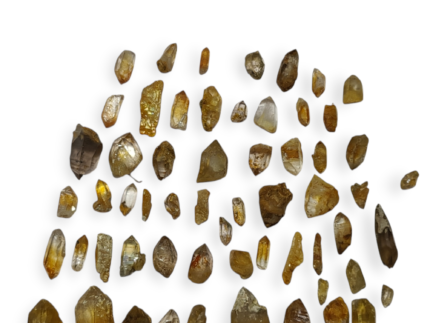
Quartz Cluster with siderite from the mine of Shigar Valley , Gilgit Baltistan, Pakistan
A quartz cluster in a sense of the term is simply a natural clustering of individual quartz crystals growing together in good circumstances- with that crystal affecting the shape and growth of the neighbouring crystals. These specimens are not only appreciated because of their sheer beauty but also because of the amazing things which their shapes tell us about the history of the Earth in its geological past.
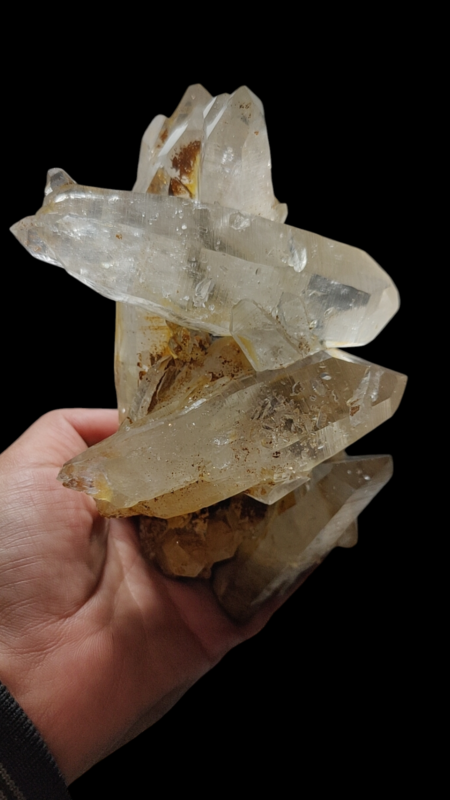
2. Geology and Formation of Quartz Clusters
Quartz clusters typically form in several geological settings:
A. Pegmatites
Pegmatites are un-uniform grains of igneous rocks and they are the rocks that crystallize in the last phases of magma. They are usually large crystal formations because their growth is slow in the presence of water-saturated melts. Pegmatite quartz crystals may become extremely large and emerge as aesthetic clusters having multiple crystal points.
B. Hydrothermal Veins
Quartz is often deposited by hot mineral rich hydrothermal fluids that flow through cracks and fissures of crustal rocks. When the fluids are cooled, the quartz crystals develop in open cavity called the vugs or geodes and they tend to form cluster groups and not isolated crystals.
C. Alpine Clefts and Metamorphic Terranes
Quartz may also develop at a very slow rate in the narrow crevices of high-pressure metamorphic regimes, called alpine clefts. The quartz in such environments tends to be very clear and well-developed terminations because of the gradual and uninterrupted growth.
The mountainous geology of Gilgit-Baltistan offers exactly these conditions, with deep tectonic crustal rocks fractured and uplifted by the impact between the Indian and Eurasian tectonic plates, forming the perfect hydrothermal reservoirs within which the crystallisation of the quartz can be performed.
3. Gilgit-Baltistan: A World-Class Quartz Locality
In Gilgit-Baltistan, including Skardu, Hashupi Mine, and Tormiq Valley are notable in the world due to their quality quartz specimens.
A. Shigar Valley
Some of the best clear and smoky quartz clusters possible are to be found here–they have very sharp endings, are very transparent, and have multi-crystal clusters that cannot be ignored.
B. Tormiq Valley & Roundu District
Close by Shigar, also there is a good supply of spectacular quartz specimens, occasionally enriched by an addition of iron, or some other mineral inclusions, which give a groundy colour, and a distinctive figure, to the crystals.
4. Quartz with Siderite from Skardu and Gilgit-Baltistan
The quartz crystals that accompany siderite are also one of the more interesting combinations that can be found in the area. Siderite is an iron-carbonate mineral (FeCO 3 ) which sometimes occurs in the same geological setting with quartz, particularly in hydrothermal veins.
A. What Makes Quartz + Siderite Special
-
Visual Contrast: The siderite may be creamy beige or rusty brown, and this would be a dramatic contrast with the bright glassy quartz. Distinct Growth Mode: Siderite can be found as tabular or rhombohedral crystals which tend to cluster around quartz points or at the matrix making specimens appear sculptural and nearly architectural.
-
Rarity:
Quartz siderite is less common than quartz with other more common mineral inclusions such as chlorite or hematite that mineral collectors find of interest.
Since siderite is not as abundant in the Pakistani mineral suites, it can be used to cite a specimen that is not only a combination of quartz and siderite but also a rare find and can be of greater interest.
5. Varieties of Inclusions in Quartz Clusters
Quartz frequently incorporates other minerals during crystallization, which can result in spectacular aesthetic effects:
A. Hematite
Iron oxide that can appear as red-rust colored coatings or internal streaks.
B. Rutile
Thread-like or needle inclusions, often golden, creating “rutilated quartz.”
C. Chlorite
Green mineral inclusions that can create mossy or phantom effects.
D. Actinolite
Dark, slender inclusion crystals adding depth and contrast.
Each of these inclusions contributes not just to the beauty but also to the scientific story of formation conditions.
6. Physical and Mineralogical Properties of Quartz
A. Structure
Quartz crystallizes in the hexagonal crystal system, commonly forming six-sided prisms with six-sided pyramidal terminations.
B. Hardness
It has a Mohs hardness of 7, making it quite resistant to scratching.
C. Luster
Quartz has a vitreous (glass-like) luster, especially noticeable on polished faces and terminated points.
D. Fracture
Quartz exhibits a conchoidal fracture, meaning it breaks with smooth curved surfaces rather than along cleavage planes.
These properties make quartz both durable and visually appealing in natural cluster form.
7. Uses and Significance of Quartz Clusters
A. Aesthetic and Decorative
Quartz clusters make stunning display pieces for homes, offices, museums, and galleries due to their natural form and brilliance.
B. Scientific and Educational
Clusters serve as excellent teaching specimens to demonstrate crystal growth habits, mineral associations, and geological conditions.
C. Metaphysical and Healing Perspectives
Many people believe quartz amplifies energy and promotes clarity of thought, while clusters can radiate energy outward from multiple points.
8. How to Describe and Market Quartz with Siderite
If you’re presenting a specimen, focus on:
-
Crystal clarity and terminations
-
Contrast between quartz and siderite colors
-
Size, weight, and locality (e.g., Skardu/Gilgit-Baltistan)
-
Formation story / geological origin
-
Inclusion description and rarity
I can help you craft professional specimen descriptions for catalogs or marketplaces if you want them!
-
Introduction to Quartz: History & Science
-
Quartz Crystal Structure & Mineralogy
-
Geological Settings of Quartz Formation
-
Quartz in the Himalayan Orogeny
-
Gilgit-Baltistan: Regional Geology
-
Detailed Localities (Shigar, Hashupi, Tormiq, etc.)
-
Quartz with Mineral Associations (siderite, rutile, chlorite, etc.)
-
Siderite Mineralogy & Associations
-
Collecting Ethically in Pakistan
-
Properties & Uses (Scientific, Industrial, Metaphysical)
-
Market & Valuation of Quartz Specimens
-
Care, Display & Photography of Clusters
-
Personal & Cultural Narratives of Quartz in the Region
-
Case Studies of Notable Specimens
-
Glossary, References, Appendices