


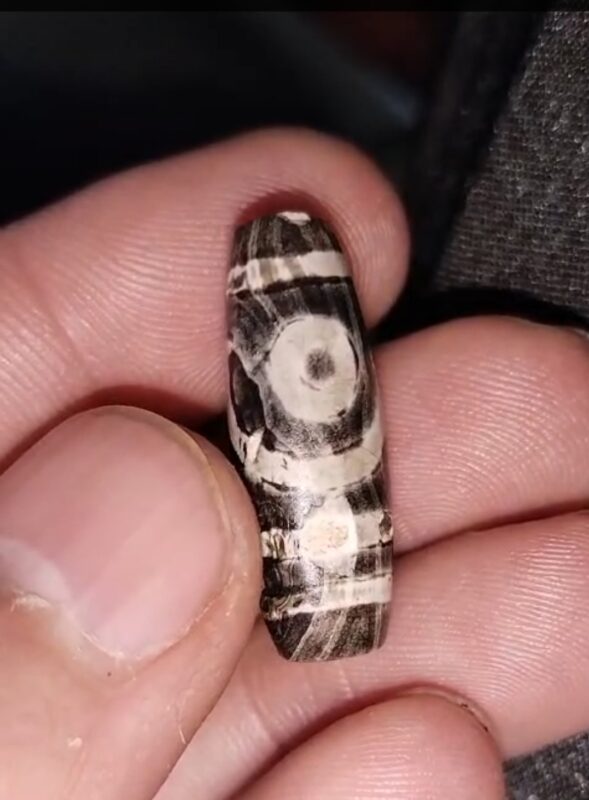
The bead in your picture is a striped Dzi bead, a very prized etched agate amulet which is traditionally Tibetan and Himalayan. Such beads are not only known due to their unique vision but also significant cultural, spiritual, and historical significance. They have been valued and preserved over centuries as talismans of protection and status, wealth, and spiritual force.
Table of Contents
TogglePhysical Description and Symbolism
This piece seems to be a banded or striped Dvis bead. It has dark brown to almost black agate bottom that has clean white horizontal lines across the surface. The bead is long and cylindrical or tubular in shape with a smooth polished surface that could have been due to long handling with time or it could have been done with care during manufacture. Occasionally called line Dvi or banded Dvi, striped Dvi beads can be symbolically interpreted to mean the unity of heaven and earth, stability, grounding, and balance in life.
Material and Ancient Manufacturing Technique
True Dvis beads are crafted with natural agate which is a type of chalcedony quartz. There are unique patterns that are not painted but etched in the stone chemically. The ancient techniques of production were the use of agate related to plant extracts, alkaline substances and heat to etch the surface permanently with the desired design. This is an ancient process that cannot be recreated even by the modern production because the real old Dvis beads are very unique and valued.
 Estimated Age Categories
It is very hard to say the exact age of a Dvi bead without testing in any laboratory. Nevertheless, the types of beads that fall under this category are mostly divided into various historical types. Old specimens may be one thousand and more to two thousand years old and are very rare and precious. Old or ancient trade beads ordinarily date back between one hundred and five hundred years and they were common across Tibet, Nepal and Bhutan. Vintage or contemporary traditional beads can be as few as several decades or as old as a hundred years but can be of great cultural and collector value.
Likely Age of This Specific Bead
The type of bead in your image is most likely a Tibetan trade item of antique or vintage, between fifty and two hundred years old, based on the apparent attributes. It may be an older one, yet the verification would be possible only with professional analysis. The signs that could indicate age are the well-worn surface, minor imperfections in the bands, minor abrasions or chips, and a natural patina that is formed due to prolonged use and handling.
Authenticity Considerations
The words are deceptive when individuals inquire about whether a Dys bead is original or not. Your bead seems to be of pure agate and is styled in the old Dzi style instead of being plastic or glasses. It must have been crafted or made with old fashioned methods. But it is not necessarily a two thousand year old object or an ancient specimen worth of a museum. Much of the authentic beads available nowadays are trade artifacts of the antique era not primitive.
Historical Use and Social Status
The Dvi beads of Ancient Dvi were one of the priciest things in the societies of Himalaya. It was also found sewn in clothes, on special ceremonies, and also in trade because they were of great price. A true old Dvis bead was usually considered a symbol of good luck, prosperity and social status.
Methods of Expert Verification
The specialists use surface wear, pattern quality, drilling techniques and the inner features of the stone to verify these beads. True older beads are generally heavily worn showing a smooth polish, micro-scratches, rounded edges, and minor imperfections to the etched pattern. The holes of the drills can be conical, and the natural agate accessories can be banding and inclusions.
Market Value Factors
Different market values of Dvis beads are unbelievable based on their age, authenticity, rarity and condition. Contemporary reproductions can be sold at comparatively low prices, whereas vintage traditional beads can enter in the range of several hundred or even more than a thousand dollars. Old Tibetan work can fetch thousands of dollars and old Dvis beads have actually fetched unbelievable prices. Judging by outward appearance, the bead you have might be collectible, but it would require professional estimation.
Scientific Authentication Techniques
Some of the scientific authentication techniques are microscopic, ultraviolet examination, spectroscopic, and provenance research. The cruel cleaning or hostile testing should never be done at all as it may diminish the historical value as well as the market value.
Conclusion
To sum up, the bead in your picture seems to be a vintage Tibetan-style striped Dvis agate bead of outstanding cultural value and collectibility. Probably it is an antique or old object of trade but not a very old object but still, it is a significant object of the Himalayan tradition and spiritual heritage.
I could also write a fully SEO-compliant article, an EEAT-compliant research article, a high-converting sales description, an estimated Pakistani market value analysis, or a comprehensive Urdu translation of the article specific to Pakistani readers. What you would like to tell me.