


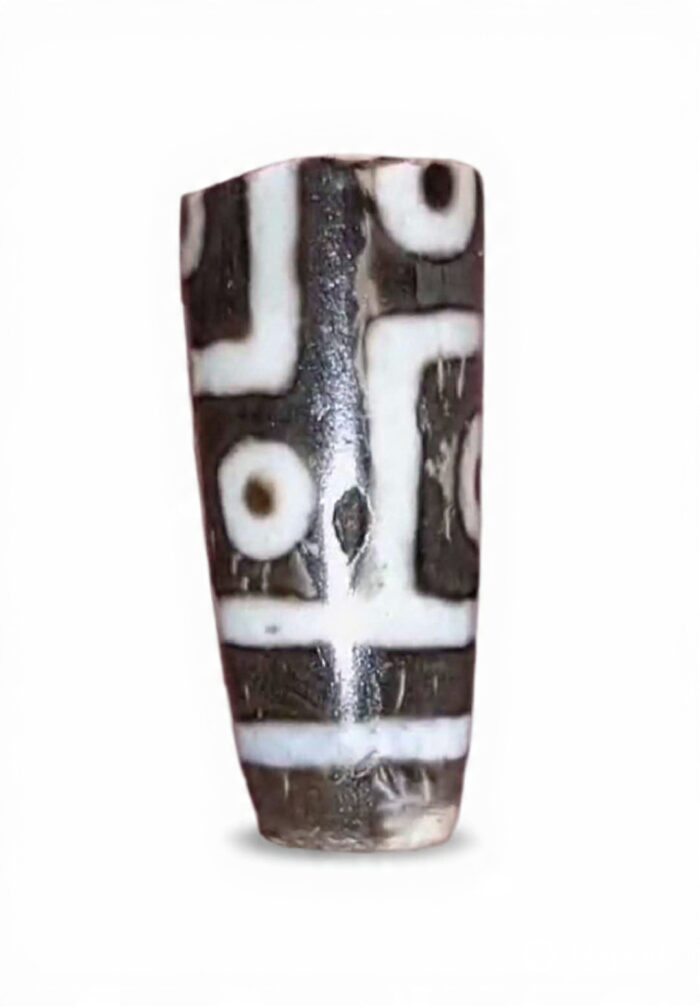



This bead is one of the Tibetan Dzi beads (pronounced as zee), which is one of the most mysterious and the most valuable beads in the world. You can use the deep research-type explanation that is given below to examine a detailed article.
What This Bead Is: Tibetan Dzi Bead
The bead you have has traditional white cut designs on dark brown/black agate backing, which is what distinguishes genuine Dvis beads.
It most closely resembles a:
👉 Cross-pattern / Geometric Dzi (sometimes linked to “Heaven & Earth” or protective motifs)
👉 Possibly a variant of Two-Eye or Multi-Symbol Dzi
🏔️ Origin and Cultural Background
Dzi beads come from the Himalayan region, especially:
-
Tibet
-
Bhutan
-
Ladakh (India)
-
Nepal
-
Gilgit-Baltistan (Pakistan) — historically on the Silk Route
They are deeply connected to Buddhist, Bon, and pre-Buddhist traditions.
Many Tibetans believe Dzi beads are:
-
Sacred talismans
-
Gifts from heavenly beings
-
Objects with protective spiritual power
-
Living stones that choose their owner
Ancient Dzi beads are called “Ancient Tibetan Dzi” and can be over 1,000–3,000 years old.
🧪 Material and Construction
Authentic Dzi beads are made from:
👉 Banded agate (a form of chalcedony quartz)
Characteristics:
-
Extremely hard (Mohs hardness ~7)
-
Smooth polished surface
-
Natural banding inside the stone
-
Often semi-translucent under light
Etching Technique
The white designs are not painted.
They are created using an ancient process:
-
Agate bead is shaped and polished
-
Surface treated with plant sugars or alkalis
-
Heated to penetrate the stone
-
Acid-like substances bleach the pattern
-
Re-polished
This process permanently alters the stone.
✨ Meaning of the Symbols on Your Bead
Your bead shows:
✔ Cross-like geometric forms
✔ Circular “eye” motifs
✔ Linear bands
These patterns commonly symbolize:
🛡️ Protection
Cross patterns often represent protection from evil and negative energy.
🏺 Age Categories
Dzi beads are usually classified as:
1. Ancient Dzi
-
Pre-1000 CE (some claim older)
-
Extremely rare
-
Museum-level pieces
-
Very high value
2. Old / Antique Dzi
-
Several hundred years old
-
Still highly prized
3. Modern Dzi
-
Made in recent decades
-
Often from China or Tibet
-
Decorative or spiritual use
Your bead’s authenticity and age require expert testing.
💰 Value Factors
Price depends on:
-
Age
-
Condition
-
Pattern rarity
-
Provenance
-
Material quality
-
Market demand
Approximate ranges:
-
Modern: $10 – $300
-
Old/Antique: $500 – $10,000+
-
Ancient authentic: $20,000 to millions
(Some museum pieces are priceless.)
🔍 Signs Experts Examine
Professionals look for:
-
Natural wear patterns
-
Internal agate structure
-
Micro-fractures from age
-
Patina inside drill hole
-
Tool marks
-
Surface texture under magnification
🌏 Historical Mystery
No one knows exactly who first made Dzi beads.
Theories include:
-
Ancient Tibetan artisans
-
Indus Valley trade routes
-
Persian or Central Asian origins
-
Lost technologies
They were traded along the Silk Road for centuries.
🧵 Traditional Uses
Dzi beads are commonly:
-
Worn as amulets
-
Set in necklaces or bracelets
-
Passed down through generations
-
Used in prayer or meditation
-
Placed in sacred altars
In Tibet, inheriting a Dzi bead is considered extremely fortunate.
🧠 Interesting Cultural Beliefs
Some legends claim:
-
Dzi beads were once insects that turned into stone
-
They fell from the sky
-
They move or disappear if mistreated
-
They bring karma-based fortune


