


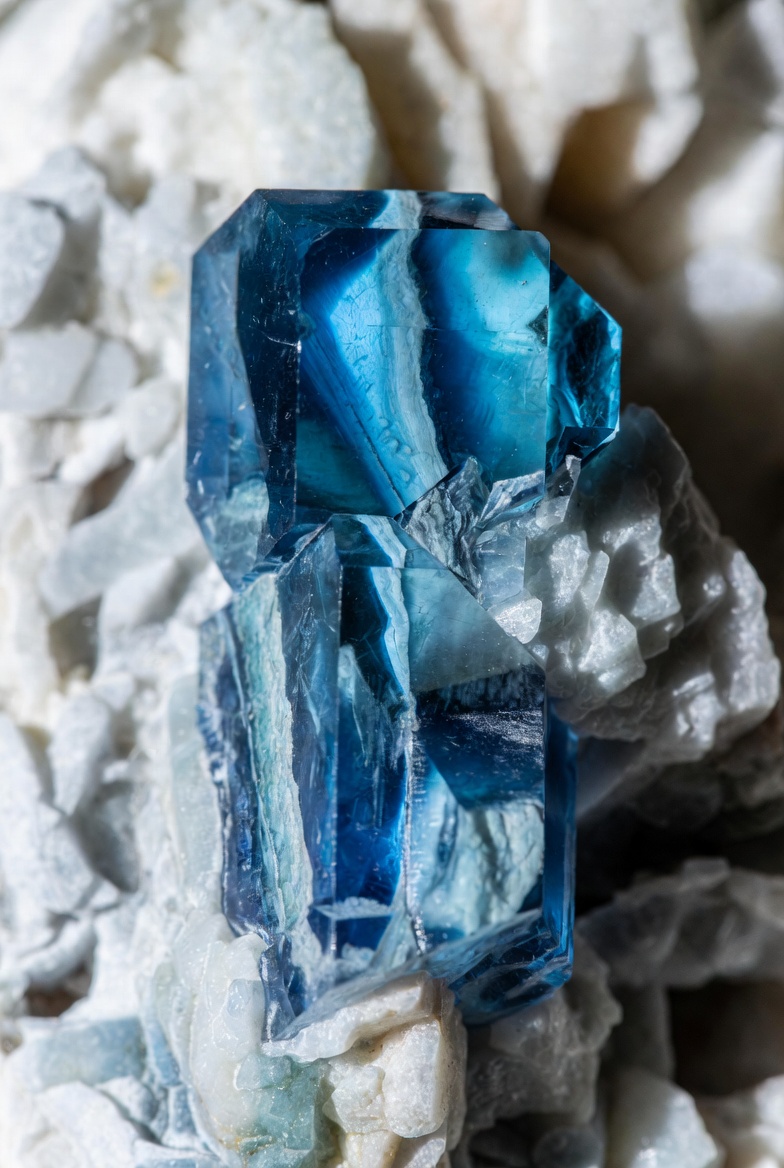
The Azure Treasures of the Karakoram: Pakistan’s Legendary Lazulite from the Laila Mine
Man, when you ever have an opportunity to hike up in Gilgit-Baltistan you will come upon the wild snowy mountains on which the Karakoram and the Himalayan ranges collide. The coolest phosphates are in the Laila mine and the Skardu region: lazulite. These crystals are bright-blue to blue-green, nearly as though they have been torn out of an alien sky. They typically occupy a matrix, displaying that trichroism phenomenon-o-how-they-change-colour-when-you-view-them-at-different-angles-and so-on and they have been an instant success with mineral collectors and gem narcissists since they burst out in the late 90s.
As opposed to that notorious lapis lazuli, whose blue is solely lazurite, lazulite is in fact a magnesium aluminum phosphate. It is the Mg-rich end of a solid-solution group with its iron-rich scorzalite. The equation is (Mg,Fe)Al 2 (PO 4 ) 2 (OH) 2, although the Pakistani stones contain super high Mg and therefore produce some very cleaner blues rather than the darker iron heavy tones.
Mineral Properties and Optical Magic
Lazulite measures at approximately 5.5-6.0 on Mohs hardness, thus is not very bad when processing jewelry as long as you take care of it but is very flimsy when used as an everyday ring. The stone is vitreous lusted and white streaked. Its crystals are mostly tabular or bipyramidal and mostly twinned and may be transparent or translucent. Its most interesting effect is its pleochroism, which is, in good specimens, trichroism, or rather three colors on viewing it under different colours: a deep blue, greenish-blue, and even yellowish, or even nearly colourless.
Good Pakistani lazulite will appear slightly dark or dull in the interiors or in a low light environment, but in the sunlight or bright lights it erupts into deep saturated colours. That is an addition to its allure as a display specimen, which is popular to spin around and watch the changing colors. Good rough of gem is a rarity; the great majority of the stones cut are small (less than 2 carats, but there are exceptions to this rule), and they usually contain inclusions, and to have a gem cut clean your carver must be a precision tool.
The Laila Mine and the Legendary Late-1990s Finds
The Laila mine, or Laila Base Camp is, therefore, the chief one, in the Haramosh Mountains in the Kutwal Valley in Gilgit District, Gilgit-Baltistan within the larger area of Skardu, which produces much of the gem mining on a high altitude. These are distant, inaccessible locations that are elevated such that mining activities are intermittent and strenuous and only occur during the short season of summer.
Important findings at this site in the late 1990s yielded crystals that have redefined the species both in terms of size, clarity, and color. Up to these discoveries, lazulite was commonly referred to as massive, or granular, material elsewhere in the world; the Pakistani crystals were gemmy, acutely shaped, and may be several centimeters in size, with many of them having a high degree of transparency making them facet/carvable. The scale and quality of that have not been duplicated anywhere in the neighbourhood, and the paintings of that epoch which have survived are the stuff of legends in the museums of collectors.
The specimens are commonly deposited on a contrasting background of another phosphate – usually white quartz, siderite or another phosphate – producing the distinctive blue on white aesthetics. Even the finest specimens bear in some cases well-formed, blocky or tabular crystals with glassy faces, occasionally of miniature size or even of small-cabinet size.


Gem-Quality Material and Collector Appeal
Pakistani lazulite is hard to come by. It is generally a deep blue-green, with a touch of green glitter as you view it at different angles- trichroism. A clean gem over a few carats? Practically, a myth; the small ones fetch high bids among those that take its brash color and the legend about its creation.
Matrix specimens are in fact appreciated even more by collectors. A combination of that deep color, the crystal shape and an impressive contrasting matrix makes them unique pieces in any mineral collection. Important rough crystals, tens of grams in weight, are retained to serve as carving material, but most are stored as natural specimens.
-8991-p.jpg?v=9F260387-5167-4F05-9119-2C2C4AC0FC80)

A Gem-Rich Region
The Laila mine is, therefore, located in one of the productive mineral provinces of the planet. During my Geology lesson we were taught that Gilgit-Baltistan is the source of aquamarine (known as the world-best), topaz (and various types of it, mostly golden and pink), tourmaline, fluorite, garnet, and numerous other pegmatite and metamorphic gems. These other treasures were concentrated by the same geological processes as the lazulite the high grade metamorphism of silica containing rocks and intrusion of pegmatites.
Lazulite is commonly associated with quartz, kyanite, muscovite and andalusite among other phosphates, indicating the complicated metamorphic and hydrothermal history of the Karakoram.
@pak.minerals — 💎✨ Lazulite from Laila, Gilgit ✨💎 Deep in the mountains of the Gilgit District, the earth reveals one of its hidden treasures — Lazulite, the stone of wisdom and calm. 💙⛰️ With its rich deep blue crystal glow, each piece from Laila, Gilgit tells the story of ancient Himalayan beauty and powerful natural energy. 🌌💫 #Lazulite #GilgitGemstones #PakistanMinerals #HimalayanCrystals #NaturalBeauty
Geology and Formation
Lazulite is usually formed at high pressure and high temperature conditions and this normally occurs in metamorphic landscapes or in some pegmatites. The mineral was found in Pakistan in the Haramosh range crystallizing in pockets and fractures of metamorphic host rock. The violent tectonic activities between the India- Asias plate collision zone provided the most favorable environment where phosphate rich fluids could be deposited to form these beautiful crystals.
Why Pakistani Lazulite Stands Out
Although a minor amount of lazulite is found in some locations, such as Rapid Creek in Canada, Minas Gerais in Brazil, and in the U.S, the Laila specimen is very unusual due to its bright blue-green color, strong trichroism, and well formed crystals on a beautiful matrix. These discoveries, made in the late-1990s, made the mineral more than a cool rock in the lab, but a hot collector object. Today, even works of the time are still very popular, and new stock is more or less a lottery win.
Caring for and Appreciating Lazulite
Lazulite is not very hard and usually contains inclusions and, therefore, it is best to treat the jewelry slightly so as to wear them as pendants, earrings or even in secure conditions. The lighting is important when displaying pieces, when it is faint the pieces look gentle and mysterious when it is bright and shine electric.
Lazulite seems to me to be a collector treasure, a gemological curiosity, and a geological miracle, of one of the most dramatic mountain-ranges of the planet. The Pakistani spec of the Laila mine demonstrates how marvelous Earth could be, particularly at the remote high places. These blue-green jewels continue to show that the most beautiful minerals are sometimes found in the most inaccessible locales.
These phosphate crystals were slowly formed over a period of millions of years, and they sat there, under the extreme but stunning scenery of GilgitBaltistan, where towering over ancient valley peaks are the likes of Laila among other phosphate crystals made available only in the late 1990s, when they were discovered during the digs. Their vibrant hues and changing tones perfectly approximate the mood of the high Karakoram that is very strong, scarce, unforgettable.

The Laila Peak and Haramosh Mountains provide the dramatic backdrop for these extraordinary mineral finds.