


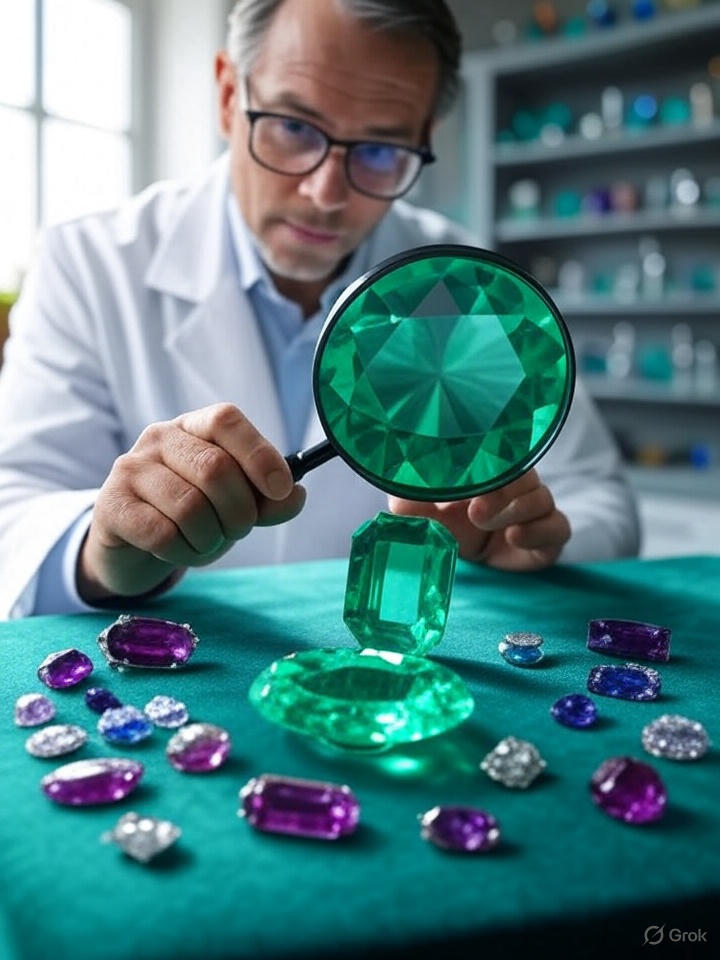
Gemstones dazzle in charm with their exquisite beauty, rare nature and place in culture. Regardless of whether you are buying a gemstone to make jewelry, investment, or just to look at you need to make sure that it is authentic. Given that synthetic, lab-created, and imitation stones are everywhere so it is important to understand how to identify a real gemstone in order to avoid overpriced errors.
![Blue emerald-cut stone held with tweezers]
It might be intimidating to decide whether a gemstone is real, when you are not a professional. Although certain tests imply using the experts, there are simple ways in which you can test the authenticity of your stone at home. In this guide, we will take you through simple methods through which you can determine how your gemstone looks like, give you tips on related procedures that you can carry out at home and show you when you need professional assistance. Equipped with this knowledge, you will not only guarantee checking your gemstone but also be sure of safeguarding your investment.
What Are Gemstones?
Gemstones are simply natural minerals or rocks which are cut and polished to bring out their appearance. They are valued depending on their factors such as rarity, quality, and looks. In order to learn whether the gemstone is genuine you should know some of its major traits like weight, color and the way it handles the light.
- Weight and Density: Each gemstone possesses a certain size weight. An orange may serve as an example: A real diamond will be heavier than an equally huge piece of glass.
- Color and Clarity: Gemstone appeal is determined by its color (hue), its intensity (saturation) and how much light it can transmit through it (transparency). Real colors, characterized by brightness, and minor flaws, in many cases, can speak of genuineness.
- Luster and Sparkle: Luster refers to the direction in which a gemstone reflects the light and Sparkle (or fire) to the way the light gets scattered into colors. The glow received by natural gemstones can be unique and hard to imitate by the synthetics.
These features are color, clarity, weight, and light effects, which you must acquire so that you would be more confident to know that your gemstone is authentic. Connections to charts or guides where properties of gemstone have been listed can also assist you to compare your stone to known standards.
Understanding Gemstones
Gemstones are natural rocks or minerals, which are processed by cutting and polishing. The quality and nature of a gem stone largely interdicts its worth in the market. To know whether a gemstone is a real or fake one, a person should be well-informed about all the physical and optical characteristics of gems.
Physical attributes such as density, weight as well as specific gravity of gemstones are important. The measurements may assist in determining the kind of a mineral that constitutes the stone. As an example, the gem with greater specific gravity will be felt heavier as compared to another stone with smaller specific gravity yet of the same size.
In examining a gemstone, the hue, saturation and transparency are essential determinants of the beauty of a gemstone. Hue is the main color of the stone and saturation is the density of the same. Transparency is the amount of light that can go through the stone. The gems that are clearer will not only look better but also more natural-looking.
The Facebook and sparkle of a gemstone are critical optical properties to take into consideration. Luster is how the stone gives out light and fire describes how light disperses in when entering into the stone. Optical qualities of a gemstone contribute immensely to how the stone looks as well as its value.
When learning more about gemstones, it is possible to conduct numerous investigations with the help of different instruments and manners including investigating tables and reading bullet points of the qualities of a specific gemstone. To sum up, it is important to state that the identification of the physical and optical characteristics of a gemstone is the most important condition of determining its validity and market value. One is likely to easily and wisely evaluate the quality of a gemstone by majoring on the factors such as density, weight, specific gravity, hue, saturation, transparency, luster and fire.
Spotting Real vs. Fake Gemstones
![Diamond and blue pear-shaped ring under magnifying glass]
Key Differences
Natural gemstones are created naturally underground over thousands or millions of years, and synthetic ones are produced in the laboratory. It is understandable that the gems that have been made in a laboratory can appear the same way, there is a way to recognize the originality:
- Inclusions: The natural gemstones usually contain small imperfections or inclusions (such as specks or cracks) and they are distinct. Artificial gems such as cubic zirconia can be overly good-looking or possess artificial designs.
- Color Consistency: Authentic gems will exhibit a little bit of variation in color, but synthetic ones will tend to be of the same color and be too bright.
- Weight: Man made stones such as cubic zirconia are heavier as compared to natural gems of equal size.
How to Verify Authenticity
Here are practical ways to check if your gemstone is real:
- Look Closely: Look at the asterite through a jeweler loupe (small magnifying glass) to check the asterite has any natural inclusions in it or minor imperfections. Real gems hardly appear perfect.
- Check Light Behavior: How light bends in the gem can be measured with a refractometer (sold at some jewelry stores) and used to determine what type of gem it is. Relate the results with known gemstone values.
- Test Density: In case you possess a scale, weigh the gem and compare the weight with the known values of its size and type. As an illustration, the density of diamonds and cubic zirconia is different.
- Get a Professional Opinion: In cases that it is a valuable gemstone, have a certified gemologist or a lab thoroughly appraise them. They make use of sophisticated tools that establish authenticity.
Remember the existence of other gem groups such as simulants (substances that compare to a gem but with distinct characteristics) or treated stones (actual gems that have undergone the procedure of heating or use of chemicals). These can influence value yet in some instances they are still authentic.
Professional Gemstone Testing
![Diamond and purple stone ring under magnifying glass]
To be on the safe side, it is possible to refer to a professional gemologist who will be able to identify the gem exactly with the help of special equipment and techniques:
- Visual and Microscope Checks: Eyebrow experts observe color, clarity and small internal characteristics through the use of microscopes in order to detect natural characteristics.
- Advanced Tools: Gemologists would verify the identity of the gem by measuring the behavior and chemical composition of light using the instrument called refractometers, polariscopes or spectrometers.
- Certification: Reputable labs, like the International Gem Society, issue certificates detailing a gem’s authenticity, quality, and characteristics. These are crucial for valuable stones.
- Appraisal: A professional appraisal estimates the gem’s market value, useful for insurance or resale.
Relying on a gemologist ensures confidence in your gemstone’s authenticity, especially for high-value or rare stones.
At-Home Gemstone Testing Tips
![Variety of stones with tweezers and magnifying glasses]
You can perform basic checks at home to get a sense of your gemstone’s authenticity:
- Visual Check: Use a magnifying glass or loupe to look for natural inclusions or flaws. For example, emeralds often have visible cracks, while fakes may look too clean.
- Hardness Test: Scratch the gem against a surface of known hardness (use caution to avoid damage). Gemstones like diamonds (Mohs 10) are much harder than glass (Mohs 5.5).
- Light Test: Shine a light through the gem to observe its transparency or sparkle. Some gems, like topaz, may show double refraction (splitting light into two images).
- Weight Check: Compare the gem’s weight to its size using a small scale. Charts online can show expected weights for specific gems.
Be cautious with treated gems, which may have undergone heat or chemical enhancements to improve appearance. These are still real but may have lower value. For accurate results, combine at-home tests with professional verification.
Understanding Gemstone Value
A gemstone’s value offers clues about its authenticity. Key factors include:
- Price: Real gemstones typically cost more due to their rarity and quality. Suspiciously cheap stones may be fakes.
- Quality (The 4 Cs): Check color (vivid and natural), clarity (fewer inclusions), cut (precision), and carat weight (size). Real gems often have slight imperfections.
- Market Trends: Genuine gemstones hold steady value, while fakes fluctuate. Research market prices for your gem type.
- Setting: Real gems are often set in high-quality metals like gold or platinum, while fakes may use cheaper alloys. Check for metal hallmarks (e.g., “14K” for gold).
By evaluating these factors, you can better judge whether your gemstone is genuine.
Rare Gemstones from The Rare Gem
![Round green stone held with tweezers]
At The Rare Gem, we specialize in extraordinary gemstones with unique traits:
- Alexandrites: These rare chrysoberyl gems shift from green in daylight to red or purple under incandescent light. With a hardness of 8.5, they’re durable and highly valued, rivaling diamonds.
- Padparadscha Sapphires: Known for their sunset-like pink-orange hue, these corundum gems score 9 on the Mohs scale, making them ideal for jewelry. Their rarity makes them collector favorites.
- Taaffeites: These magnesium aluminum garnets range from red to purple to bluish-gray (hardness 8–8.5). Often mistaken for spinel, they’re prized for their scarcity.
- Grandidierites: With a striking bluish-green color and hardness of 7–7.5, these borosilicate gems are extremely rare, especially in larger sizes.
These gems may resemble more common stones like aquamarine or tourmaline but have distinct properties. Knowing their hardness and unique features helps confirm their authenticity.
Mastering Gemstone Identification
![Purple stone with tweezers and magnifying glass]
Identifying gemstones takes practice and patience. Here’s how to build your skills:
- Research: Study gemstone properties using reliable sources like books, reputable websites, or gemology courses.
- Observe: Visit gem shows or jewelers to examine stones up close. Note their color, luster, and inclusions.
- Use Tools: Practice with a loupe or microscope to spot natural features. Online gem identification charts can guide you.
- Stay Objective: Avoid assuming a stone is real or fake without evidence. Re-evaluate if needed.
With time, you’ll gain confidence in spotting genuine gemstones versus imitations.
Frequently Asked Questions
What tests can identify gemstones?
Airline tests may be common tests on color and how clear the diamond is, refractive index using refractometer, check under a UV light, or on hardness. Tests should be highly complex to be handled by professionals.
How can I spot a fake gemstone?
Check for abnormally cheap prices, unnaturally perfect looks, consistent color or artificial gloss. Fakes can be also heavier or lighter than a person believes.
What do gemstone certificates do?
Certificates of reputable labs support the authenticity, origin and quality of a gem. They are necessary to precious stones and add buyer confidence.
How do inclusions affect authenticity?
Natural inclusions (such as small cracks) are a sign of a genuine gemstone, since synthetics either have no or have unnatural patterns.
Can I test gemstones at home?
Sure, you can test color, clarity or weight at home, but you need a professional testing to be sure. Home tests are only the point of beginning, they are not an answer.