


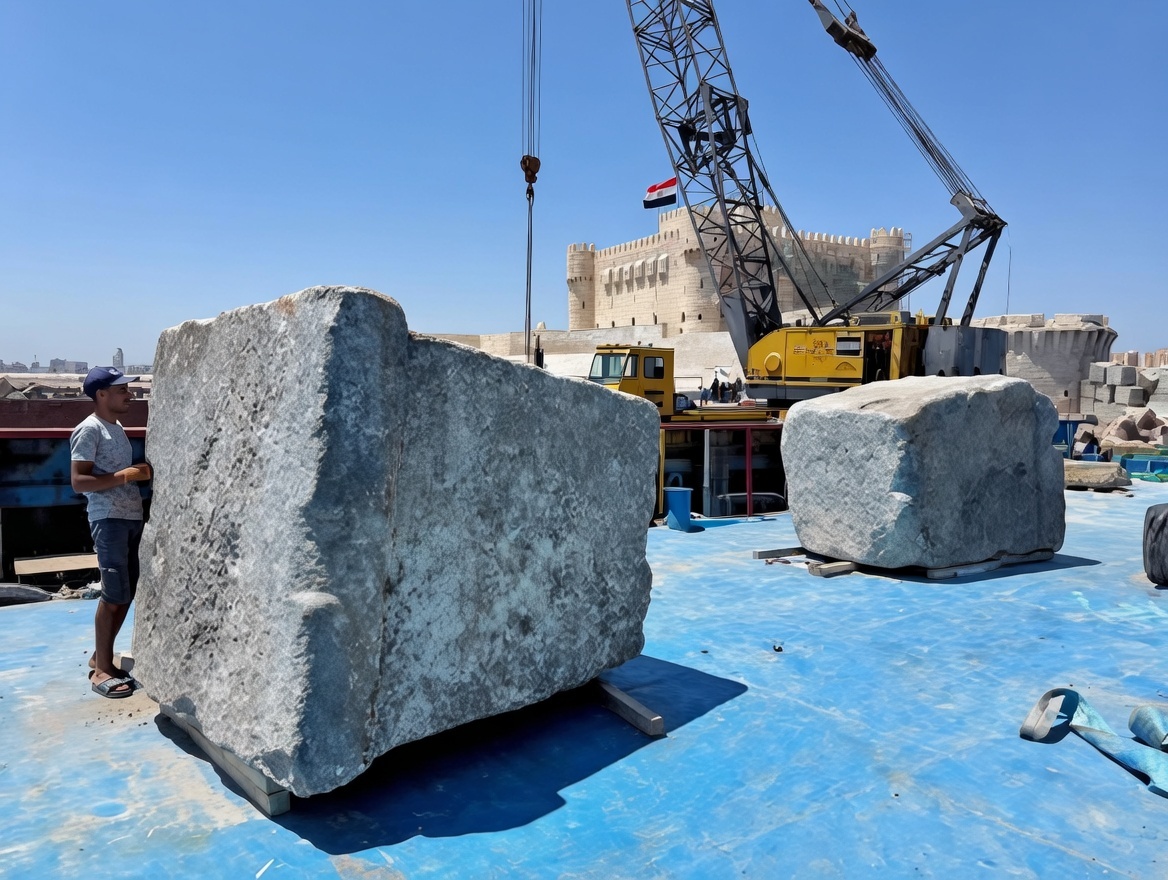
In Egypt, archaeologists have excavated 80 tonne stones off the ocean floor associated with one of the seven wonders of the ancient world.
Recovery Operation in the Eastern Harbour of Alexandria
A significant underwater endeavour has followed in the Eastern Harbour of Alexandria, Egypt whereby archaeological teams have been successful in bringing to the surface 22 large stone blocks that are firmly attached to the Lighthouse of Alexandria.
Historical Significance of the Lighthouse
Another one of the seven wonders of the ancient world, the lighthouse, existed only in history and legend centuries before it was actually rebuilt.
But with the modern technology, archaeologists have unearthed stones which have been associated with the mythical structure.
Recovered Architectural Elements
Other architectural features that were part of the recovery were lintels (horizontal beam above a doorway), door supports, thresholds and large paving slabs.
Discovery of an Unknown Pylon-Like Structure
Among the most important findings is the unknown pylon-like structure that houses what is suspected to be an Egyptian-style doorway caught them off guard at the lighthouse, which means that the construction of the lighthouse was quite possibly more elaborate than before thought with the structure design showing elements of both Egyptian and Greek influence.
The Pharos Project and Digital Reconstruction
The archeological site, led by archeologist Isabelle Hairy, is part of the international Pharos project who is hoping to create a digital twin (acre-by-acre level virtual reconstruction) of the lighthouse.
Research Methods and Analysis
The researchers will scan and examine the recently discovered stones in detail, to study the construction and design methods and formulate the hypotheses about how the construction was performed and how it appeared.
Origins of the Pharos of Alexandria
The remnant of the Pharos (lighthouse) of Alexandria was constructed in the early 3rd century BC under the reign of the Ptolemaic Kingdom of Ancient Egypt, Ptolemy II Philadelphus (280–247 BC).
It is approximated that it was at least 100 metres tall and over centuries, it was among the tallest man-made structures in the world.
Destruction of the Lighthouse
By the beginning of the 14th century AD, the lighthouse had been destroyed due to a series of earthquakes which had started around the 4th century AD leading to a gradual erosion and submergence of the shoreline and surrounding city.
After the lighthouse was destroyed, the ruins were long-lost over centuries.
Rediscovery of the Remains
Only after local authorities made efforts to preserve yet another archaeological site, the Citadel of Qaitbay, were the remnants of the lighthouse rediscovered.
Extent of the Underwater Archaeological Site
The drowned archeological site is a minimum of 13,000 square metres and has over 3,000 distinct parts that are between 2.6 and 8.5 metres under the water level.
They consist of architectural blocks, statues and metal like bronze, iron and lead fixings which were used to shape the original structures.
Long-Term Excavation Efforts
Underwater excavations started systematic digs in 1994 and the site is studied by a number of annual missions since the time, the site is surveyed and detailed maps and databases are made of the material found there.
New Historical Interpretations
Researchers claim that after a period of over 20 years of research, they can now put forward their own interpretation of the site historically and begin to rebuild the monuments that once existed there a bit.
Institutional Support
The French National Centre Scientific Research and the Egyptian Ministry of Tourism and Antiquities support the project.